
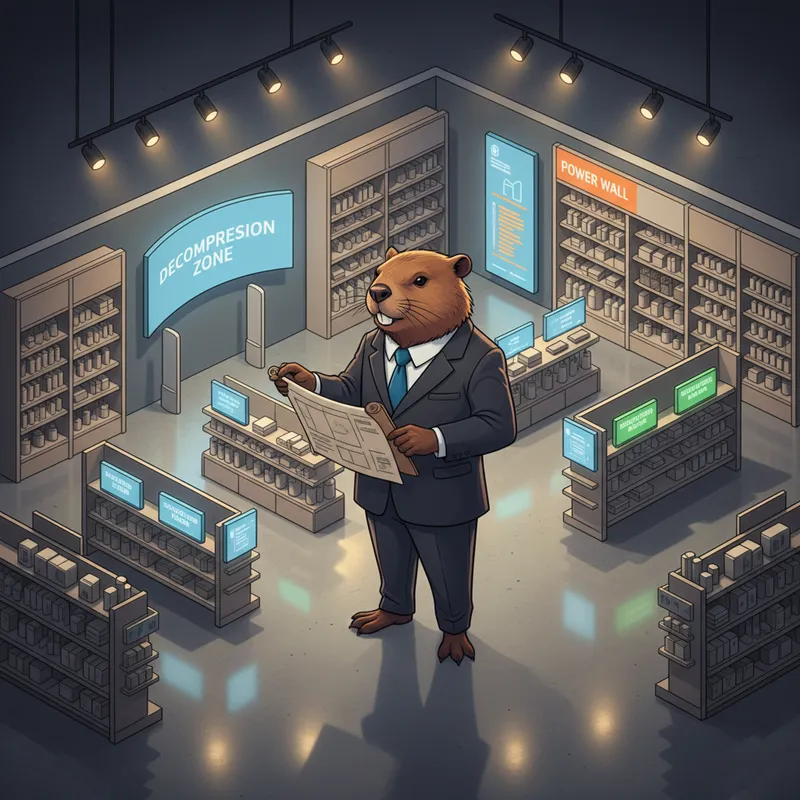
Most retail marketing advice focuses on timing—when to show your message. But the real secret to effective in-store marketing isn’t about the “when.” It’s about the “where.”
Think about it: a perfectly timed promotion means nothing if your customer never sees it. Meanwhile, a well-placed message at a decision point can turn a browser into a buyer, regardless of what day or time it is.
This is the fundamental insight behind multi-zone retail marketing strategy. It’s not about flooding your store with messages. It’s about achieving the right density of touchpoints at the right locations throughout the customer journey.
Let’s explore how strategic placement of digital signage across your retail zones can transform your in-store marketing effectiveness.
Why Placement Beats Timing in Retail Marketing
The retail industry has long understood that store layout impacts customer behavior. But too many businesses still approach digital signage as a “set it and forget it” installation—putting up a screen or two without thinking strategically about placement.
The problem? A survey by Mood Media and MyTotalRetail found that 58% of shoppers actively notice in-store displays, and nearly half of those say their purchase decisions were influenced by those displays. But here’s the catch: location determines whether your signage falls into that noticed 58% or the ignored 42%.
Research on touchpoint exposure in retailing reveals that frequency of exposure to different types of touchpoints influences brand consideration, and there is a relationship between different levels of frequency of exposure to touchpoints and loyalty intentions.
In other words: Touchpoint density matters more than touchpoint timing.
When you place digital signage strategically across multiple zones in your store, you’re not just showing more messages. You’re creating a cohesive customer journey that guides, informs, and persuades at exactly the moments when customers are most receptive.
Understanding Retail Store Zones
Before we can talk about strategic placement, we need to understand the psychological zones that exist in every retail space. These aren’t just arbitrary divisions—they’re based on decades of research into customer behavior and visual merchandising.
The Decompression Zone
The decompression zone is the first 5 to 15 feet inside your store entrance. This area serves a critical psychological function: it helps customers transition from the outside world into “shopping mode.”
Here’s what’s counterintuitive: don’t put important signage or merchandise in the decompression zone.
Why? Because shoppers will miss it. They’re still adjusting to the new environment, getting their bearings, and aren’t yet in a purchasing mindset. Retail design experts recommend keeping this area open and uncluttered, avoiding any promotional materials that might overwhelm customers before they’ve even started shopping.
Digital signage strategy for decompression zones:
- Use this space for simple welcome messages or wayfinding
- Keep messaging minimal and non-promotional
- Focus on brand identity and store navigation
- Avoid expecting customers to make purchase decisions here
The Power Wall
Once customers pass through the decompression zone, research shows that approximately 90% of shoppers will turn right. This makes the right-side wall one of the most valuable pieces of real estate in your entire store.
This area is known throughout the retail industry as the “power wall,” and it’s where you should prominently display your best products and most important brand messages.
Digital signage strategy for power walls:
- Showcase hero products or seasonal campaigns
- Place screens at eye level (30-60 inches from the floor)
- Use bold, high-impact visuals that catch attention immediately
- Feature your highest-margin items or bestsellers
- Include clear calls-to-action that direct customers deeper into the store
Decision Points and High-Traffic Zones
Throughout your store, there are specific locations where customers naturally pause to make purchasing decisions. These include:
- End caps at the end of aisles
- Cross-aisles where customers choose which direction to go
- Checkout counters where waiting time creates opportunity
- Product discovery zones near complementary items
Point-of-sale marketing is particularly effective at these decision points because the limited decision-making time increases the chance of quick, unplanned purchases. In fact, POS marketing is often described as a game-changer for sales figures.
Digital signage strategy for decision points:
- Place screens where customers naturally pause or wait
- Show relevant product information, comparisons, or promotions
- Keep messages concise—customers are making quick decisions
- Use dynamic content that rotates based on nearby inventory
- Include impulse-purchase promotions near checkout
Speed Bumps and Focal Points
Beyond the major zones, retailers use what are called “speed bumps”—displays placed strategically to slow customers down and encourage them to shop rather than simply pass through.
These might include:
- Feature displays just past the decompression zone
- Seasonal promotions in the center of sight lines
- Product demonstrations or sampling stations
- Interactive displays that encourage engagement
Digital signage strategy for speed bumps:
- Use screens to draw attention to featured displays
- Employ motion graphics to catch the eye
- Showcase video demonstrations or product features
- Create “Instagram-worthy” displays that customers want to photograph
The Density Principle: Getting the Mix Right
Now that we understand the zones, let’s talk about the critical concept that ties it all together: touchpoint density.
This isn’t about putting a screen on every wall. It’s about creating the right frequency of messaging throughout the customer journey—enough to guide and inform without overwhelming or annoying.
How Much Is Too Much?
Research on retail touchpoints suggests that the common advice of “more is always better” is misguided. While some practitioners argue that if you have 50 touchpoints you should have 51, the reality is that value and quality matter more than quantity.
In fact, retailers report that the most cited pain point for customer-facing digital signage is customers ignoring it or failing to notice it (61%). Additionally, 56% of retailers say digital signage can be intrusive to the customer experience and actually frustrate customers.
These problems typically stem from two sources:
- Poor content (irrelevant, outdated, or low-quality)
- Poor positioning (screens placed where they interrupt rather than enhance the experience)
The Right Density Formula
Here’s a practical framework for determining touchpoint density in your retail space:
Zone-based placement:
- 1 screen in the decompression zone (optional, for wayfinding only)
- 1 screen on the power wall (essential)
- 1 screen per major decision point (end caps, departments, service areas)
- 1-2 screens near checkout (depending on line length)
- 1 screen per specialized zone (fitting rooms, waiting areas, pickup counters)
For a typical small retail store (1,500-3,000 sq ft), this usually means 3-5 strategically placed screens rather than 10+ scattered randomly throughout the space.
Mapping Your Store’s Zones
To implement a multi-zone strategy effectively, start by mapping your actual customer flow:
- Observe customer paths: Track where customers naturally walk, pause, and make decisions
- Identify dwell time: Note areas where customers spend the most time
- Mark decision points: Highlight locations where purchases are considered or made
- Consider sightlines: Determine what customers can see from each position
- Map screen placement: Position digital signage to intersect with high-value moments
Retail layout experts recommend aligning screen placement with key shopper moments: entrances for high-impact campaigns, main aisles for seasonal themes, and promo zones for shoppable content.
Implementing Multi-Zone Digital Signage with BrandCast
Understanding the theory is one thing. Actually implementing a multi-zone digital signage strategy is another. This is where the right platform makes all the difference.
Start with What You Have
One of the biggest barriers to implementing digital signage is the assumption that you need to buy expensive proprietary hardware. Not true.
BrandCast works with the devices you already have—tablets, smart TVs, or even repurposed computer monitors. This BYOD (Bring Your Own Device) approach means you can:
- Start with one or two screens in your highest-priority zones
- Expand gradually as you see results
- Repurpose existing hardware instead of making major capital investments
- Test different placements before committing to permanent installations
Zone-Specific Content Strategies
Once you have screens placed strategically, the next challenge is creating zone-appropriate content. Each zone requires different messaging:
Decompression Zone Content:
- Store hours and location information
- Brand videos that establish identity
- Simple wayfinding (“Sale items to the right →”)
- Special events or announcements
Power Wall Content:
- Hero products with compelling visuals
- Seasonal campaigns and promotions
- Brand storytelling videos
- Product demonstrations
Decision Point Content:
- Product specifications and comparisons
- Customer reviews and testimonials
- Cross-sell and upsell suggestions
- Limited-time offers and urgency messages
Checkout Content:
- Loyalty program information
- Impulse purchase promotions
- Social media follow prompts
- Upcoming events or sales
The key is that content should be contextually relevant to where the customer is in their journey. BrandCast makes it easy to schedule different content to different screens based on location and time.
Measuring Multi-Zone Effectiveness
How do you know if your multi-zone strategy is working? Track these metrics:
Conversion metrics:
- Overall conversion rate before and after implementation
- Zone-specific product sales (e.g., power wall featured items)
- Impulse purchase rates at decision points
- Average transaction value
Engagement metrics:
- Dwell time in different zones
- Customer paths through the store
- Foot traffic patterns
- Screen attention and viewing duration
Operational metrics:
- Content update frequency
- Screen uptime and reliability
- Staff feedback on customer questions
- Return on investment per screen
Start with baseline measurements before implementing your multi-zone strategy, then compare results after 30, 60, and 90 days.
Common Multi-Zone Strategy Mistakes
Even with the best intentions, retailers often make these mistakes when implementing multi-zone digital signage:
Mistake #1: Screen Overload
Problem: Placing too many screens too close together, creating visual clutter and competing messages.
Solution: Follow the density principle—quality over quantity. One retailer doubled purchase frequency and reduced ad spend by 10% by shifting to a personalized, omnichannel messaging strategy that emphasized strategic placement over sheer volume.
Mistake #2: Ignoring Sightlines
Problem: Installing screens where customers can’t see them from natural walking paths.
Solution: Position screens in high-visibility zones like store entrances, busy aisles, and waiting areas. Test visibility by walking customer paths yourself.
Mistake #3: One-Size-Fits-All Content
Problem: Showing the same content on every screen regardless of zone or customer intent.
Solution: Customize content for each zone’s purpose. Your power wall should showcase different messages than your checkout screen.
Mistake #4: Set It and Forget It
Problem: Installing digital signage but never updating content, leading to customer blindness.
Solution: Rotate content regularly to keep messaging fresh. Even weekly changes can significantly improve attention and engagement.
Mistake #5: Poor Content Quality
Problem: Using low-resolution images, cluttered designs, or amateur-looking graphics that hurt brand perception.
Solution: Invest in quality visuals. Your digital signage represents your brand—make sure it looks professional.
The Future of Multi-Zone Retail Marketing
As we look toward 2026 and beyond, multi-zone retail marketing strategies are becoming more sophisticated with technology:
Hyperlocal Targeting
The future of local marketing lies in precision targeting at the neighborhood level. Digital screens in retail locations can deliver ultra-targeted content based on specific building demographics, neighborhood characteristics, and real-time local events.
AI-Powered Personalization
Retailers are beginning to use AI-powered personalization to display contextually relevant promotions that adapt based on time of day, inventory levels, and even observed customer behavior patterns.
Omnichannel Integration
Retail digital marketing in 2025 is omnichannel by default, with winning brands treating e-commerce and in-store not as silos, but as nodes of a connected system. Your in-store digital signage should complement and reinforce messaging customers see on social media, email, and your website.
Retail Media Networks
By 2025, global retail media ad spending is projected to reach $179.5 billion, accounting for 23% of total digital ad spend. Forward-thinking retailers are turning their in-store digital signage networks into advertising platforms, creating new revenue streams while maintaining brand control.
Getting Started with BrandCast
Implementing a multi-zone digital signage strategy doesn’t have to be complicated or expensive. Here’s how to get started with BrandCast:
-
Map your zones: Walk through your store and identify the decompression zone, power wall, and key decision points.
-
Start small: Begin with 2-3 screens in your highest-priority zones (we recommend power wall and checkout).
-
Use existing devices: Repurpose tablets, smart TVs, or monitors you already have.
-
Create zone-specific content: Develop 3-5 content pieces tailored to each zone’s purpose.
-
Test and iterate: Monitor results for 30 days, then adjust placement or content based on what you learn.
-
Expand gradually: Add additional zones as you see ROI and gain confidence in the system.
BrandCast makes this entire process straightforward with easy-to-use content scheduling, multi-screen management, and real-time updates. You don’t need technical expertise or expensive consultants—just a clear understanding of your store’s zones and customer journey.
Conclusion: Place Over Pace
The retail marketing landscape has shifted. Success is no longer about shouting your message at the right time—it’s about positioning your message in the right place.
Multi-zone retail marketing strategy recognizes that customers move through distinct psychological zones as they shop, and each zone presents unique opportunities for engagement, information, and persuasion.
By understanding these zones and implementing strategic touchpoint density, you can:
- Increase customer engagement without overwhelming them
- Guide shoppers naturally through your intended customer journey
- Boost conversion rates at critical decision points
- Maximize ROI from your digital signage investment
The best part? You don’t need a massive budget or complex technology to get started. With a BYOD approach and a platform like BrandCast, you can implement a sophisticated multi-zone strategy using the devices you already have.
Ready to transform your retail space with strategic digital signage placement? Learn more about how BrandCast works or start your free trial today.
Have questions about implementing multi-zone digital signage in your retail space? Reach out to our team—we’d love to help you design a strategy that works for your unique store layout.